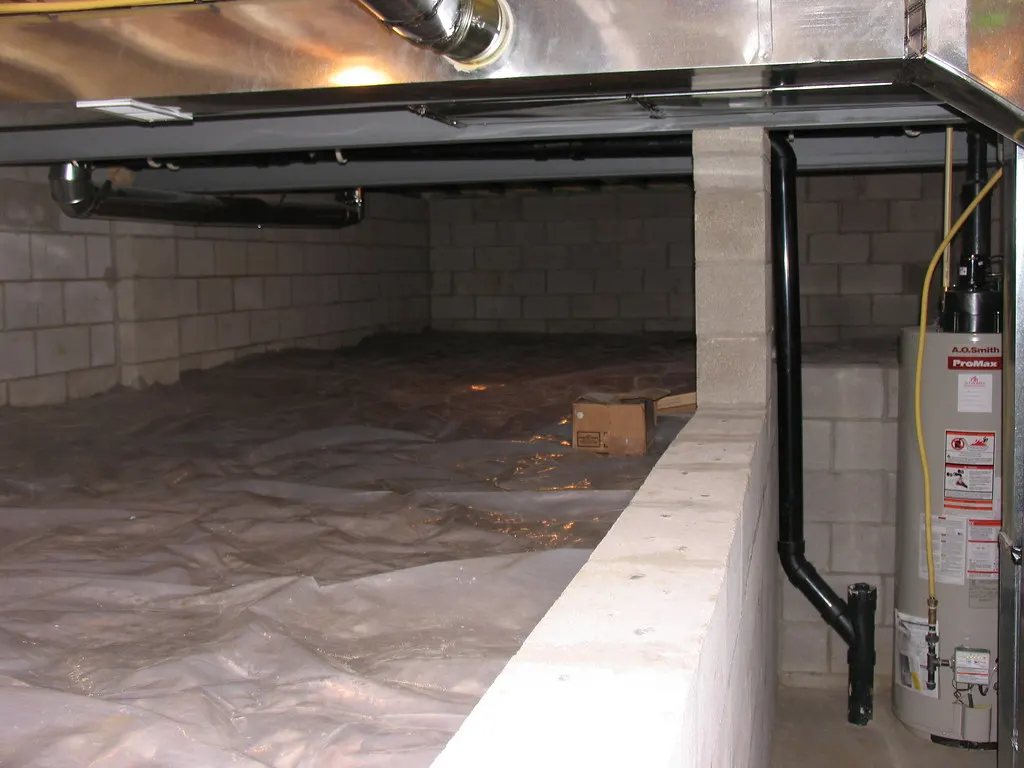
Think of encapsulation as bringing your crawl space inside the house. Instead of letting outside air and ground moisture move freely under your floors, the crawl space gets sealed off and the humidity kept in check. It's the most complete fix for a damp crawl space, and in a climate like ours it's often the one that lasts.
What crawl space encapsulation is
A traditional crawl space has a dirt floor, a few vents in the foundation walls, and maybe a thin sheet of plastic on the ground. Encapsulation replaces that setup with a sealed system. The main parts are:
- A heavy liner on the ground, run up the foundation walls and piers, with seams taped and edges fastened.
- Sealed vents and openings, so humid summer air can't flow in.
- A sealed access door, so the crawl space entry isn't a big air leak.
- Humidity control, usually a crawl space dehumidifier, so moisture that does get in has somewhere to go.
- Drainage where needed, like a sump pump or interior drain if water collects after storms.
Done right, the result is a clean, bright crawl space that stays dry year round. You can tell the difference the moment you open the hatch.
Why it matters in Statesville
Statesville summers are long, hot, and humid. Our red clay soil holds water and stays wet for days after a storm. Many older homes here were built on vented crawl spaces, and in summer those vents pull warm, wet air under the house. When that air touches cool joists and ductwork, it condenses. That's why sweating ducts, damp insulation, and mold on joists show up in so many crawl spaces around town.
Encapsulation addresses both sources of moisture at once: the ground below and the air coming in from outside.
Signs encapsulation might be right for you
- Musty smell in the house that gets worse in summer
- Mold or dark staining on floor joists or the subfloor
- Ductwork or pipes that sweat or drip
- Insulation between joists that's damp, sagging, or falling down
- High humidity readings in the crawl space (over about 60 percent)
- Floors that feel cold in winter or clammy in summer
- Pests that keep coming back
What the work involves
Every job starts with a free inspection. The contractor checks moisture levels, the wood, the ground, the walls, drainage, and the outside grading, then gives you a written quote.
A typical encapsulation job goes like this:
- Prep. The crew clears out debris, old plastic, and any failed insulation. If there's mold, it gets treated first. See crawl space mold removal.
- Drainage. If water collects in the crawl space, that gets handled before the liner goes down, usually with a sump pump or interior drain. See crawl space drainage.
- Liner. A thick, reinforced liner goes over the ground and up the walls. Seams are overlapped and taped. Piers are wrapped.
- Sealing. Vents, gaps, and the access door are sealed.
- Humidity control. The installer sets a crawl space dehumidifier sized for your space, with a drain line so you don't have to empty it.
- Walk-through. The crew shows you the finished space and explains what to keep an eye on.
Most encapsulations take two to four days. Bigger or wetter crawl spaces can take longer. You can stay home the whole time.
What it costs
Full encapsulation is the biggest moisture job in a crawl space, and the price depends on the house. Square footage, crawl space height, how much water you're dealing with, mold treatment, and whether you need drainage all affect it. A number posted online can't account for all that. Your real price comes from a free on-site inspection and a written quote. The encapsulation cost guide explains what drives it.
What to ask any contractor
Whoever you hire, these questions help you compare quotes fairly:
- How thick is the liner, and does it go up the walls and around the piers?
- Are the seams taped and the edges fastened to the wall?
- How will you handle humidity once the space is sealed?
- What's causing the moisture, and does your plan fix that cause?
- Is drainage or mold work included, or extra?
- How long will it take, and what will the space look like when you're done?
If you only need a ground liner and not a full system, a vapor barrier may be a smaller first step. A good contractor will tell you honestly which one fits.
Questions people ask
Is crawl space encapsulation worth it?
For many homes in our humid climate, yes. It stops the cycle of damp air, condensation, and mold, protects the wood framing, and usually makes the house smell and feel better. If your crawl space is already fairly dry, a vapor barrier alone may be enough. The inspection will show which makes sense.
Do I need a dehumidifier after encapsulation?
In most Statesville homes, yes. Sealing the space keeps outside air out, but some moisture still gets in. A crawl space dehumidifier holds humidity at a safe level. Some homes use a small supply of conditioned air from the HVAC system instead. Ask the contractor to talk through both.
Can I store things in an encapsulated crawl space?
Many people do. A clean, dry, lined crawl space is fine for light storage like holiday decorations in plastic bins. Avoid heavy items that could tear the liner, and keep things off the dehumidifier and sump pump.
Will encapsulation lower my power bill?
It often helps. Drier air is easier to cool, ducts stop sweating, and floors stay more comfortable. Savings depend on the house, the HVAC system, and how bad the crawl space was before, so nobody should promise you a specific number.